
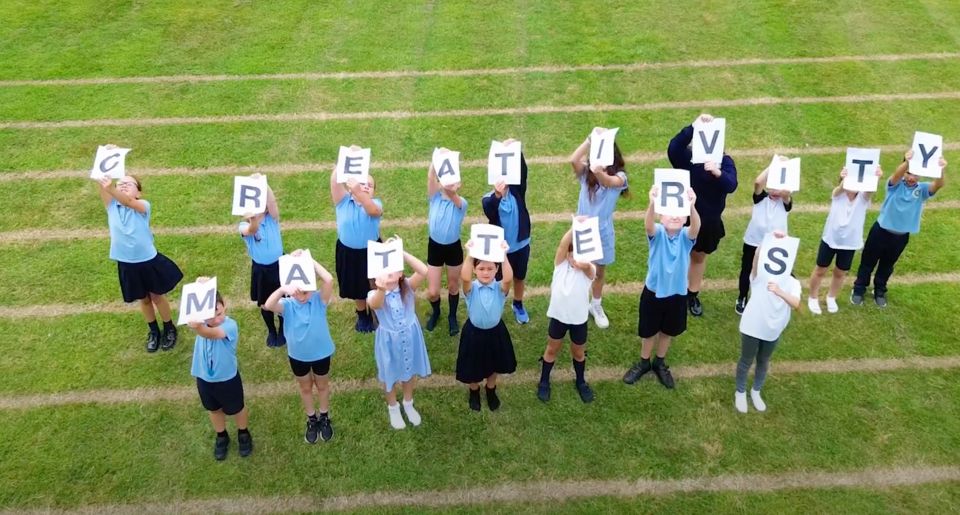
The University of Winchester has played a key role in a three-year national pilot which has shown that embedding teaching for creativity in classrooms can improve pupil engagement and help rekindle teachers’ passion for their profession.
Winchester ran one of eight Creativity Collaboratives in a programme evaluated by Durham University and funded by Arts Council England.
The programme championed the idea that creativity should not be an optional extra in schools but instead should be nurtured across all subjects and education settings – not just the Arts.
Over three years, teachers and school leaders undertook continuous professional development (CPD) and implemented strategies designed to embed teaching for creativity.
Teaching for creativity is an approach that focuses on developing pupils’ ability to think imaginatively, make connections, take risks, and generate original ideas across all subjects.
More than 4,400 primary pupils, 1,300 secondary pupils, 500 teachers and 100 senior leaders took part in the evaluation.
The programme has now been independently evaluated by a research team from Durham using surveys, reflective portfolios, interviews, case studies and workshops and their findings are set out in a report that has been published today (11 February).
For nearly two decades the University of Winchester has led thinking about creativity in schools and this programme has built on that work.
Research by Prof Bill Lucas, at the University of Winchester Centre for Real-World Learning, was instrumental in the decision by global assessment body PISA to stage the first ever global test of creative thinking.
A five-dimensional model of creativity, developed by the Centre for Real World Learning, was commended by the Durham Commission Report on Creativity in Education in 2019 and was subsequently used and adapted by most of the eight Creativity Collaboratives.
The University of Winchester Academy Trust (UWINAT) Creativity Collaborative involved a core group of 10 Hampshire infant, junior and primary schools working with the University of Winchester and partner organisations to develop leadership and teaching strategies for creativity and to evaluate their impact.
Professor Paul Sowden, at the University of Winchester School of Psychology and Social Sciences, led the work by the UWINAT Creativity Collaborative to co-develop a Creativity Navigator framework of teaching for creativity, which built upon the five-dimensional model, and to evaluate the impact of its implementation.
Professor Sowden said: “The success of the Creativity Collaboratives programme at a national level is a clarion call to education policy makers to rethink support for the cultivation of creative thinking skills and dispositions across the curriculum with the opportunity to enhance the life chances of all young people and support the future society that they will inherit.”
Nicholas Serota, Chair, Arts Council England, said: “I have seen how Creativity Collaboratives have ignited children’s enthusiasm for learning, increased teachers’ confidence in the value of teaching for creativity and supported schools to embed creativity across all subjects.
“At its heart, this work gives children and young people the skills they need to navigate an increasingly complex world.
“It is a clear success story of the Durham Commission in action, and I look forward to seeing how participating schools continue to develop and expand this impact in the next phase.”
Copies of the summary report and full research evaluation report is available to download via the following link: https://doi.org/10.62512/pubs.ed.0002.
Back to media centre