

Meet our third year Accounting and Finance students Fiza and Hridai, who both completed a placement to further their skills and career prospects.
Student: Fiza Talukdar
Placement: Parker Hannifin
Duration: 12 months
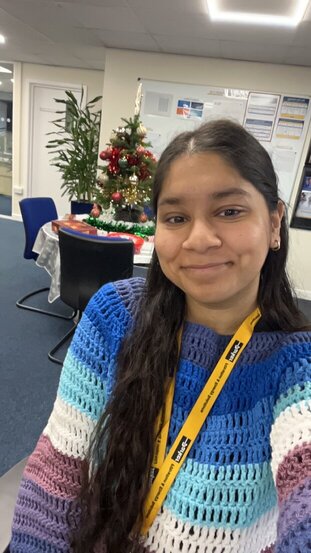
Tell us about your 12 month placement with Parker Hannifin
I first found out about Parker Hannifin through the canvas placement homepage notifications. I then applied on Career Connect where I filled in the company’s application process. Parker Hannifin is a global manufacturing company which has a business unit in Alton, Hampshire, which is where the role was based.
I decided to go for this role as a “finance intern” as I wanted to have the experience of working in the industry and because I didn’t want to finish my degree and jump into a long term accounting graduate scheme having no idea what it actually feels like to work in the workplace. I didn’t want to start my graduate scheme and then feel trapped if I didn’t enjoy it. My main concern was how different in class studies can be from applying the knowledge in the workplace and if having a full-time office job was right for me. Thankfully, I really enjoyed my placement and it further cemented for me that I did want to go into the accounting field.
What was a typical day like on placement?
A typical day for me involved driving from Winchester to Alton (30 minute drive), getting to the office, writing an agenda for the day of what needed to be done and then scheduling/prioritising. An example of this was on Wednesdays I had a meeting at 3pm where I had to present a file which I was only able to prepare that morning. Straight after this meeting at 4pm, I was in charge of a HPT (High Performance Team) project so had to also have time to prepare an agenda and minutes for the meeting and lead.
I had other tasks I needed to complete throughout the day such as report the daily sales and send some invoices to customers. I would prioritise organising the meetings first as reporting the daily sales was needed for a meeting the following morning and the invoicing to customers wasn’t needed right away but rather to just keep on top of it to make sure they aren’t piling up.
I would often have my lunch at my desk as I worked so that I could use my 1-hour lunch to go on a walk around a nearby pond to get some fresh air with some of my colleagues instead of sitting all day at my desk. I found this was very good for my mental health as we discussed topics outside of work such as what films we’ve watched recently, what fun things we’ve got up to during the weekend while looking out for the ducklings and goslings.
What key skills have you gained from your experience?
One key skill I developed was my excel proficiency. I became very familiar with manipulating pivot tables, using V/H lookups and utilising the basic accounting formulas and generic excel keyboard shortcuts. Additionally, I was responsible for preparing the monthly/quarterly VAT statement. I had never come across VAT in my first 2 years of university but during my final year, it was a part of one of my modules and I found my placement gave me a deeper level of understanding as I could apply my in class learning to what I did in the workplace regarding it.
What do you hope to do after you graduate?
I am now coming to the end of my final year of my degree and have already secured a role as a “Business Tax graduate” at S&W accounting firm in Southampton. I found that during the application/interview process, my placement gave me a plethora of achievements to talk about with a typical scenario or ‘name a time when you…’ questions which was also degree/role relevant. Also, a special shoutout to Career’s Consultant Jan Harrison who helped me every single step of the application process for my graduate scheme.
Would you recommend a placement to others considering one? (if yes, why)
I would highly recommend undergoing a placement for 2 main reasons. The first being to experience first-hand how the workplace differs from in-class learning to see if working in the field is right for you before you end up committing to it after you finish your degree. The second reason being that when it comes around to finding a full time job/graduate scheme at the end of your degree, having the placement under your belt puts you at a huge advantage. I would argue this is more valued than extra high grades as employers want to know they are hiring someone who will fit in with their company and the role, and having successfully completed a placement is proof of that and gives you lots of opportunities to talk about your placement and how you can apply what you learn from it to the role you’ll be applying to when you graduate.
Student: Hridai Patel
Placement: SS&C Technologies
Duration: 3 months
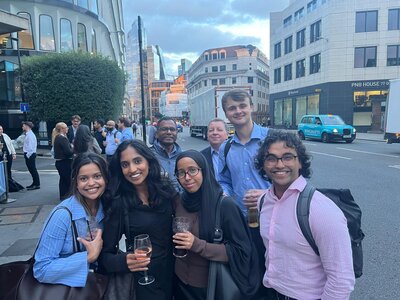
Tell us about your three month summer placement
My three month summer internship was with SS&C Technologies, working on their fund administration side specifically with the Fund of Fund Accounting team. I learnt about this company through my personal connections as they helped to encourage me to put my application forward to this side of the industry and see how it goes. It was based in London specifically around Queen Street, before offices changed and then I worked near St Paul’s Cathedral. I decided to give this internship a go because I felt it would give me the best introduction into how accounting is done within the working world and helped me realise that I could see myself doing this as a career once I finish University.
What was a typical day like on placement?
During this placement a typical day involved the commute into London, then once at the office I would work on Gocheck emails to sort through information such as Valuations, Distributions and Capital Calls preparing the emails to send through as wire transactions. Once I was more accustomed to the working day the team I worked with helped to gradually expand my workload which involved working on Bank Reconciliations and Net Asset Value pack rollforwards on my set of funds I was assigned. As well as just working for my specific team the other interns and I spent time in other teams such as Marketing, Research and Development and Product to get an understanding of how each team operates.
My total commute time was roughly one and a half hours, an hour for the train and a half an hour walk from Waterloo to the office where I would stop for a coffee before I went into the office. It was quite enjoyable as it was during summer, so the weather was great and having some downtime before the workday started was a nice start to the day. After the workday ended the team I was with were very close so they would go out for a drink afterwards when they were all in the office where we would run into the teams from other departments so it was a really nice way to get to know people and build connections. My only issue was that because my commute time was longer than most I had to leave early to ensure I could catch my train home in order to make it to the office again the next day. This was because it was required for me to be in the office five days a week to get used to working in the environment – I could work from home if there were issues such as train cancellations, however.
What key skills have you gained from your experience?
I have found that my overall knowledge of financial statements and double-entry bookkeeping had improved as I was dealing with them daily for adjusting and processing invoices. My overall financial understanding has improved because I was able to apply the knowledge I had accumulated whilst at University to the financial information I was working on which helped consolidate what I’ve learnt. My module on International Financial Reporting was helpful as SS&C Technologies is a global organisation and they operate with several jurisdictions so having an understanding of what standards apply makes it easier to know what to do and why these processes take place.
A bit about the internship that surprised me was actually the lack of constructing financial statements. It was completed by SS&Cs own technology platform called Geneva, which generated all the financial statements so my task was to input the information needed and double check it to make sure there were no errors. A struggle was having the confidence to submit tasks I had done without second guessing my ability but my manager was super helpful and ensured me I had the ability to do the work correctly which helped me get over that uncertainty.
What do you hope to do after you graduate?
My plan once I finish university will be either to pursue getting my professional accounting qualification, become a Chartered Financial Analyst (CFA) or follow a path into financial advisory as I want to help people manage their finances as it is something I have found a lot of people struggle with so being able to support others will give me a sense of accomplishment.
How did the University support you for the placement?
I found the internship through my own connections but the University helped me see how and why accepting it would benefit me and my future career progression.
Would you recommend a placement to others considering one? (if yes, why)
I would wholeheartedly encourage others to take a placement even if it is for the summer in between years at University because it can help people figure out if the jobs they were considering applying for is what they actually want to do. For me that was if I want to pursue becoming an accountant which I know for certain now is definitely a career path I would consider. As well as this just gaining professional experience will help boost their CV and make them stand out from other people who may apply for the same roles. Working with others in a professional environment is a great way to build connections and meet new people who could give advice or put you forward for other jobs, for instance I met with the senior managers at SS&C Technologies and got to organise one-to-one meetings to ask for career advice and any skills they advise me to work towards.
Back to blog