
Nursing (Adult) with Foundation Year
B74XIf you are a caring and compassionate individual, our BN (Hons) Nursing (Adult) with Foundation Year degree will help you become a highly skilled and much sought-after graduate nurse, specialising in caring for adults across a variety of settings.

Course overview
The Winchester Nursing Guarantee
We guarantee an interview opportunity for all applicants to any of the Nursing courses at the University of Winchester (T&C Apply)
The foundation year of this programme offers students with non-standard entry qualifications a comprehensive and guided academic preparation for degree-level study in Nursing.
On successful completion of the foundation year, you will progress to the NMC approved BN (Hons) Nursing (Adult).
A dynamic and interactive professional course that places the needs of patients at its centre. Throughout the course, our team of supportive and accessible lecturers will help you to realise your potential to become a caring, effective and autonomous nurse who is able to deliver and lead adult care within an ever-changing health and social care environment.
The course enables you to develop and display the values required in modern healthcare: working together for patients; respect and dignity; commitment to quality of care; compassion and improving lives. It also addresses contemporary challenges such as the ageing population, increasingly prevalent long-term health conditions and public health.
Drawing on the most up-to-date research and evidence, you are supported to develop not only your nursing skills, but also the graduate attributes required to succeed in the modern workplace.
In your first year, as a foundation student you will be based on campus. As you progress beyond the foundation year, your time as a nursing student will be split equally between learning theory on campus and applying your knowledge during placements alongside experienced professionals. You will study a range of academic core modules and field modules based on theory and practice experiences. As you progress through the course, programme content becomes increasingly complex as your knowledge grows.
On successful completion of the 4‐year programme of study you'll be eligible to register with the NMC, the professional regulatory body for nurses.
What you need to know
Course start date
September
Location
Winchester campus
Course length
- 4 years full-time
Apply
B74X
Typical offer
32 points
Fees
From £9,790 pa (Foundation year)
Why Winchester
- Make a difference to people’s lives and learn how to optimise their care in a safe and stimulating environment
- Learn from supportive and accessible lecturers and gain real insights from experienced and registered professionals
- Bring your learning to life through practice placements with partner organisations under the supervision of experienced nurses
- Develop excellent communication skills, clinical knowledge and leadership skills to prepare you for your future professional life
- On successful completion of this four-year programme be eligible to seek admission to part 1 (Adult) of the Nursing and Midwifery Council (NMC) register
- After the foundation year, the programme is accredited by the Nursing and Midwifery Council (NMC)
Course details
Work placements
Work placements are a core part of this course and account for approximately 50% of the programme after the completion of the first year.
Learning and teaching
You are taught primarily through a combination of lectures and seminars, allowing opportunities to discuss and develop your understanding of topics covered in lectures in smaller groups.
In addition to the formally scheduled contact time such as lectures and seminars, you are encouraged to access academic support from staff within the course team and the wide range of services available to you within the University.
The course uses the NHS Leadership Academy Maximising Leadership in the Pre-Registration Healthcare Curricula Framework to build leadership skills through a spiral curriculum.
Digital Literacy
Digital and technological literacy is a requirement for entry to all nursing programmes. In healthcare it is now seen as a vital tool and is used for managing patient records, assessment, research and education. It is also the most common and the preferred way we communicate with students on our programmes.
Applicants are required to apply through the UCAS system and all information exchange until starting the programme (such as interview arrangements, responding to offers and pre-course preparation) will be via digital platforms. The prospective student’s engagement in this activity will reflect the fundamental digital literacy requirements, which will then be developed through the programme itself. Students will be supported in the university to access learning opportunities using online and blended learning, as well as utilising digital platforms to prepare for and submit assignments.
Overall workload
Your overall workload consists of class contact hours, independent learning and assessment activity.
While your actual contact hours may depend on the optional modules you select, the following information gives an indication of how much time you will need to allocate to different activities at each level of the course.
Year 1 (Level 3):
Teaching, learning and assessment: 288 hours
Independent learning: 912 hours
Placement: 0 hours
Year 2 (Level 4): Timetabled teaching and learning activity*
Teaching, learning and assessment: 196 hours
Independent learning: 569 hours
Placement: 760 hours
Year 3 (Level 5): Timetabled teaching and learning activity*
Teaching, learning and assessment: 234 hours
Independent learning: 606 hours
Placement: 770 hours
Year 4 (Level 6): Timetabled teaching and learning activity*
Teaching, learning and assessment: 174 hours
Independent learning: 526 hours
Placement: 800 hours
*Please note these are indicative hours for the course.
Location
Taught elements of the course take place on campus in Winchester and the adjacent Royal Hampshire County Hospital site.
Teaching hours
All class based teaching takes places between 9am – 6pm, Monday to Friday during term time. Wednesday afternoons are kept free from timetabled teaching for personal study time and for sports clubs and societies to train, meet and play matches.
Assessment
Our validated courses may adopt a range of means of assessing your learning. An indicative, and not necessarily comprehensive, list of assessment types you might encounter includes essays, portfolios, supervised independent work, presentations, written exams, or practical performances.
We ensure all students have an equal opportunity to achieve module learning outcomes. As such, where appropriate and necessary, students with recognised disabilities may have alternative assignments set that continue to test how successfully they have met the module's learning outcomes. Further details on assessment types used on the course you are interested in can be found on the course page, by attending an Open Day or Open Evening, or contacting our teaching staff.
Percentage of the course assessed by coursework
The approximate percentage of the course assessed by different assessment modes is as follows:
Year 0 (Level 3)*:
60% coursework
13% written exams
27% practical exams
Year 1 (Level 4)*:
25% coursework
23% written exams
52% practical exams
Year 2 (Level 5)*:
38% coursework
11% written exams
51% practical exams
Year 3 (Level 6)*:
35% coursework
10% written exams
55% practical exams
*Please note these are indicative percentages and modes for the programme.
Further information
For more information about our regulations for this course, please see our Academic Regulations, Policies and Procedures
Modules
Please note the modules listed are correct at the time of publishing. The University cannot guarantee the availability of all modules listed and modules may be subject to change. The University will notify applicants of any changes made to the core modules listed. For further information please refer to winchester.ac.uk/termsandconditions
Modules
More information coming soon.
More information coming soon.
More information coming soon.
More information coming soon.
This module builds on Part 2’s Leading Self and Others in Personal and Professional Practice Module and The Effective Adult Nurse modules. The aim of this module is to enable students to plan their transition towards becoming a newly qualified nurse (NQN), enhancing personal resilience, leadership, and decision-making skills. They will also prepare to become Practice Supervisors of the future. Students will also focus on the multifactorial needs of people who access services and the role of the adult nurse in supporting them in living well, as well as consider pharmacology and being ‘prescriber ready’ as a NQN.
This module introduces you to Part 3 of the electronic Practice Assessment Document (ePAD), which requires apprentice/student nurses to take a lead in care delivery with minimal guidance and perform with increased confidence and competence. Within your allocated placement area, you will be required to maintain achievement of all the statements related to four areas of professional values: Prioritise People, Practise Effectively, Preserve Safety and Promote Professionalism and Trust. These will be signed as completed by your Practice Assessor.
This module will allow students to develop and apply their learning from the Preparation for Evidence-Based Practice Inquiry module (Year 2) by completing their own project. The inquiry project may take one of two broad forms: an audit/service evaluation or an evidence-based practice dissertation.
Modules
This module introduces learners to the nursing profession, its underpinning values and the socio-political and economic drivers that impact on the practice landscape. It will also provide the opportunity for learners to explore their own values and beliefs and how they align to the profession they are entering. Learners will finally begin to understand the core principles of nursing care delivery as part of a multi-professional team. Learning in this module will be built upon at Level 5 (Part 2) within the Leading Self and Others in Personal & Professional Practice and Effective Nurse modules.
This module introduces students to the underpinning anatomical, physiological and behavioural science that helps the nurse to understand how the ‘well’ child or adult functions and their role in promoting a healthy lifestyle that maintains homeostasis.
Within your allocated placement areas, you will be required to achieve all the statements related to four areas of professional values: Prioritise People, Practise Effectively, Preserve Safety and Promote Professionalism and Trust. You will also be required to achieve all the ePAD Part 1 proficiencies, complete the reflection on an episode of care and demonstrate proficiency in medicines management. These will be signed as completed by your Practice and Academic Assessors.
Modules
This module builds on the profession of nursing and its values, the nursing process and external drivers in UK healthcare introduced in Leading Self in Personal and Professional Practice at Level 4. The module seeks to develop these to explore the leadership of both self and others, as well as the underpinnings of decision making in practice. This module will help to prepare the learner for undertaking The Transformational Adult/Child/Learning Disability/Mental Health Nurse at Level 6.
This module follows on from Nursing Sciences and Population Health 1, support learners to apply their knowledge of anatomical, physiological, and behavioural sciences to understand the ‘unwell’ child or adult and their role in health promotion to restore optimum wellbeing.
This module introduces you to Part 2 of the electronic Practice Assessment Document (ePAD), which requires apprentice/student nurses to more actively participate in care delivery with minimal guidance and perform with increased confidence and competence. Within your allocated placement area, you will be required to maintain achievement of all the statements related to four areas of professional values: Prioritise People, Practise Effectively, Preserve Safety and Promote Professionalism and Trust. These will be signed as completed by your Practice Assessor.
This module will develop knowledge and understanding of practice inquiry and the service improvement process, contextualised within a chosen topic area. Students will be exposed to a range of tools/approaches to systematic review of literature, change management and quality improvement used within healthcare. Students will critically appraise evidence from a range of sources to support a project proposal for their Year 3 project. This proposal will take the form of an audiovisual presentation of an academic poster.
This module provides you with an opportunity to identify an area for personal and professional development, which may be addressed through a self-managed placement experience. This module carries 120 hours of practice towards the requirements for NMC registration.
This module builds on the profession of nursing and its values, the nursing process and external drivers in UK healthcare introduced in Leading Self in Personal and Professional Practice at Level 4. The module seeks to apply these specifically to the field of Adult Nursing and prepare the learner for undertaking Transformative Adult Nursing Practice at Level 6.
Modules
This module introduces you to Part 3 of the electronic Practice Assessment Document (ePAD), which requires apprentice/student nurses to take a lead in care delivery with minimal guidance and perform with increased confidence and competence. Within your allocated placement area, you will be required to maintain achievement of all the statements related to four areas of professional values: Prioritise People, Practise Effectively, Preserve Safety and Promote Professionalism and Trust. These will be signed as completed by your Practice Assessor.
This module will allow students to develop and apply their learning from the Preparation for Evidence-Based Practice Inquiry module (Year 2) by completing their own project. The inquiry project may take one of two broad forms: an audit/service evaluation or an evidence-based practice dissertation.
This module builds on Part 2’s Leading Self and Others in Personal and Professional Practice Module and The Effective Adult Nurse modules. The aim of this module is to enable students to plan their transition towards becoming a newly qualified nurse (NQN), enhancing personal resilience, leadership, and decision-making skills. They will also prepare to become Practice Supervisors of the future. Students will also focus on the multifactorial needs of people who access services and the role of the adult nurse in supporting them in living well, as well as consider pharmacology and being ‘prescriber ready’ as a NQN.
Entry requirements
UCAS tariff points required: 32
The UCAS tariff points can come from 1 A-level (grade C or above) or an equivalent qualification. You will also need:
- GCSE English and Mathematics at grade C/4 or above
- A clear commitment to pursuing a career in nursing
- To be at least 18 years old
However, all applicants will be judged on their individual merits and we may take other skills, qualifications and life experience into account. We welcome mature students without the usual formal qualifications and will consider your application based on your suitability and preparedness to complete the Foundation Year.
The BA Nursing (Adult) with Foundation Year is aimed at individuals who may have few or no relevant formal qualifications but who can demonstrate a clear commitment to pursuing a career in nursing. Personal, professional and educational experiences will be considered to determine motivation and ability to progress onto the degree course.
If you will be over the age of 21 at the beginning of your undergraduate study, you are considered a mature student. At Winchester this means our offer may be different, taking into account any work or life experiences you have, alongside any qualifications you hold.
Nursing Interview
Shortlisted candidates will be invited to attend an interview, and will be expected to demonstrate that they have an understanding of the requirements of nursing. Information about this day will be sent to all invited applicants.
Additional Requirements
You are required to demonstrate health and character sufficient to ensure safe and effective healthcare practice. This includes a satisfactory Enhanced DBS and occupational health clearance.
If English is not your first language you will need to show that you have language skills at IELTS (Academic) with an overall score of 6.5 and a minimum of 6.0 in the writing component.
If you are living outside of the UK or Europe, you can find out more about how to join this course by contacting our International Recruitment Team via our International Apply Pages.
2026/27 Course Tuition Fees
| UK / Channel Islands / Isle of Man / Republic of Ireland |
International |
|
|---|---|---|
| Foundation year | £9,790 | £16,700 |

Additional tuition fee information
*(UK / Channel Islands / Isle of Man / Republic of Ireland) £9,790 for the 26/27 academic year. Subsequent years of study currently attract fees of £9,790 per academic year. Please see 3 year programme course page(s) for further details. Fees for future academic years will be determined in line with our Terms and Conditions. The fee is currently subject to a governmental fee cap for each academic year. It is our policy to charge tuition fees at the level of the cap set by the Government. If the cap set by the Government changes, then we may increase our Fees in line with governmental policy.
*(International) £16,700 for the 26/27 academic year. Fees for future academic years will be determined in line with our Terms and Conditions. We decide the annual level of increase of our Tuition Fees by taking into account a range of factors including the cost of delivering the course and change in governmental funding.
Remember, you don’t have to pay any of this upfront if you are able to get a tuition fee loan from the UK Government to cover the full cost of your fees each year.
Additional costs
As one of our students all of your teaching and assessments are included in your tuition fees, including, lectures/guest lectures and tutorials, seminars, laboratory sessions and specialist teaching facilities. You will also have access to a wide range of student support and IT services.
There might be additional costs you may encounter whilst studying. The following highlights the mandatory and optional costs for this course:
Mandatory:
One uniform will be provided but you are likely to require additional uniforms. Indicative cost: £30.
This programme requires an occupational health assessment and clearance, which is provided free of charge to all students. In exceptional circumstances, the costs of specific appointments and any related administrative charges may be passed on to the student. Where this applies, the total amount would not exceed £200.
You will need a pair of suitable comfortable shoes while on clinical placement. Indicative cost: £40–£60.
You will need to purchase some of your own clinical items, for instance a stethoscope and fob watch. Indicative cost: £30.
As part of your course, you will be expected to participate in placements. These may be located across a wide geography and if you have access to your own transport you will be expected to travel independently to placements.
If you use your own motor vehicle, you will need to have business mileage included in your insurance.
Please note, driving to the University’s campuses is not encouraged as parking on site is restricted and there is limited public parking in the local community. Further information about travelling to our campuses is available on our Travel and Transport pages.
All students who accept an offer for this course are required to obtain an Enhanced Disclosure and Barring Service (DBS) clearance check. Please note, the cost of the check is £49.50 and covering the cost is the responsibility of the student.
In addition to the check, all students are strongly encouraged to sign up to use the DBS Update Service [https://www.gov.uk/dbs-update-service] for the duration of their course. Students who fail to sign up to the Update Service may be required to complete and pay for an additional check during their course which may affect their ability to engage successfully with placements.
SCHOLARSHIPS, BURSARIES AND AWARDS
We have a variety of scholarship and bursaries available to support you financially with the cost of your course. To see if you’re eligible, please see our Scholarships and Awards.
CAREER PROSPECTS
As a registered nurse there are opportunities to work in the UK and many countries across the world in a range of care environments. This includes statutory health care providers (such as the NHS), the private voluntary and independent sector, criminal justice system and armed forces. Further education, training and experience can lead to advanced nurse practitioner roles, healthcare management, nursing research and roles within nurse education.
The University of Winchester ranks in the top 25 in the UK for graduates in employment or further study according to the Graduate Outcomes Survey 2024, HESA.
Pre-approved for a Masters
University of Winchester students studying Bachelor Honours degrees are pre-approved to start a Masters degree at Winchester. To be eligible students must apply by the end of March in their final year and meet the entry requirements of their chosen Masters degree.
OUR CAREERS SERVICE
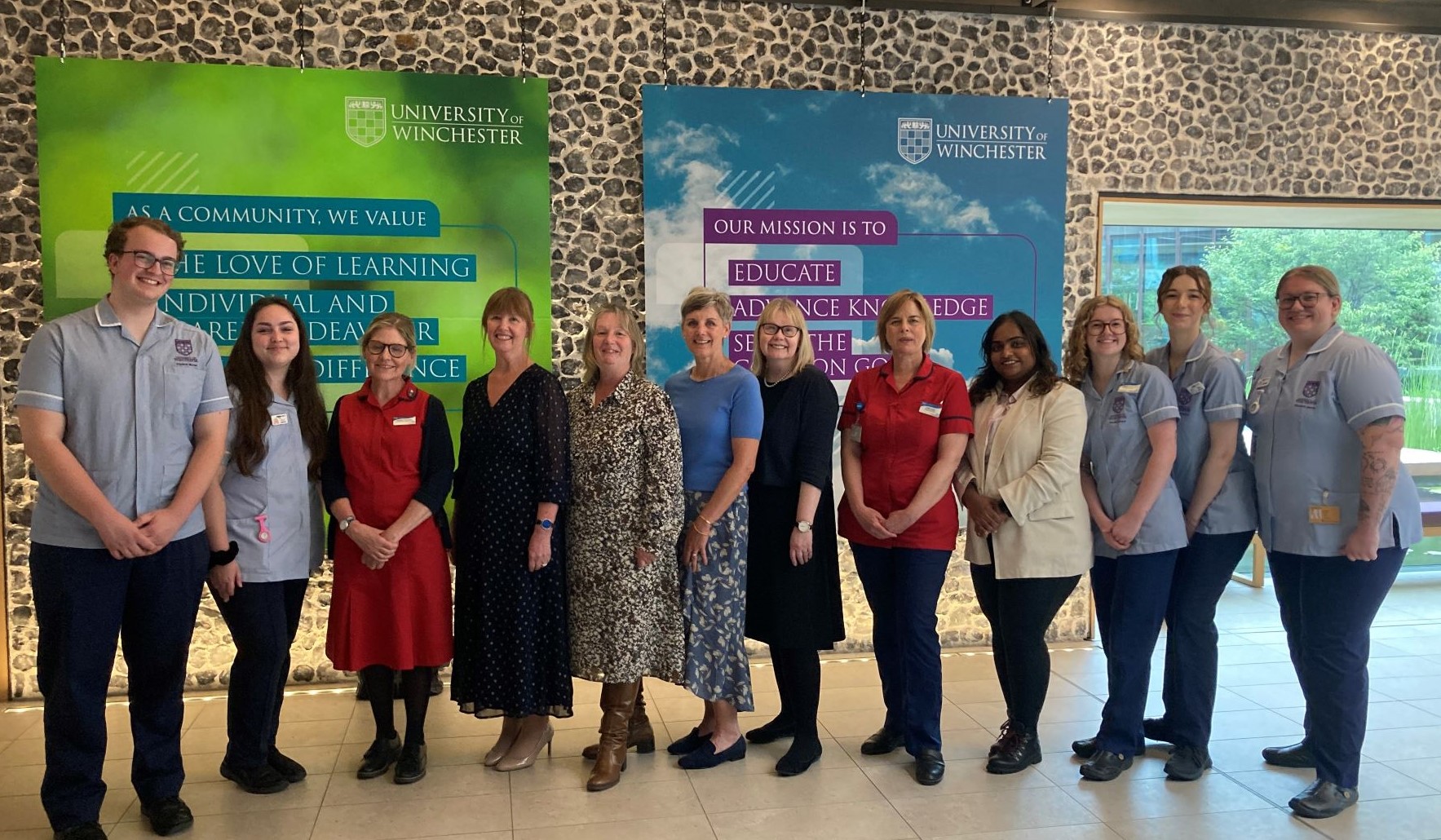
Read about the International Nurses Day event 'Why I Still Love Nursing' hosted by the University. Julie Dawes, Chief Nurse at Hampshire Hospitals Foundation Trust, said the best thing about being a nurse was her colleagues. "I am inspired every day by the people I work with who regularly go above and beyond."