

Russia’s regional leadership in Eurasia was the subject of a recent talk given to the Russia, Ukraine and Caucasus Regional Centre by Sean Roberts, Senior Lecturer in Politics and International Relations, and Ulrike Ziemer, Senior Lecturer in Sociology at the University of Winchester. In this blog the pair of expert Russia watchers look at Vladimir Putin's hold over the former Soviet states and the impact of recent elections in Armenia.
Far from the front line of Russia’s war of aggression in Ukraine, a series of high-profile summits held in Kazakhstan (May 27-29) as well as Armenia’s parliamentary election (June 7) reveal the limits of Russia’s leadership in its self-proclaimed ‘sphere of privileged interests’. Despite growing trade between Russia and close partners, the rise of China and the acrimonious split with Armenia confirm Moscow’s declining regional influence.
An unusually intensive period of diplomatic activity saw the Republic of Kazakhstan – a close regional ally of Russia – host three major summits in May, marking its rotating chairmanship of the Eurasian Economic Union (EAEU). The EAEU, comprising Russia, Armenia, Belarus, Kazakhstan, Kyrgyzstan, was created in 2015 as a rival to the European Union (EU) and a way for Moscow to institutionalise its regional leadership ambitions.
Indeed, at the surface level, there are signs that both Russia and the EAEU remain internationally attractive and economically viable, despite the impact of Russia’s prolonged war in Ukraine. Although western sanctions on both Russia and Belarus have complicated economic relations, the EAEU continues to grow, with mutual trade expected to exceed $100 billion for the first time in 2026.
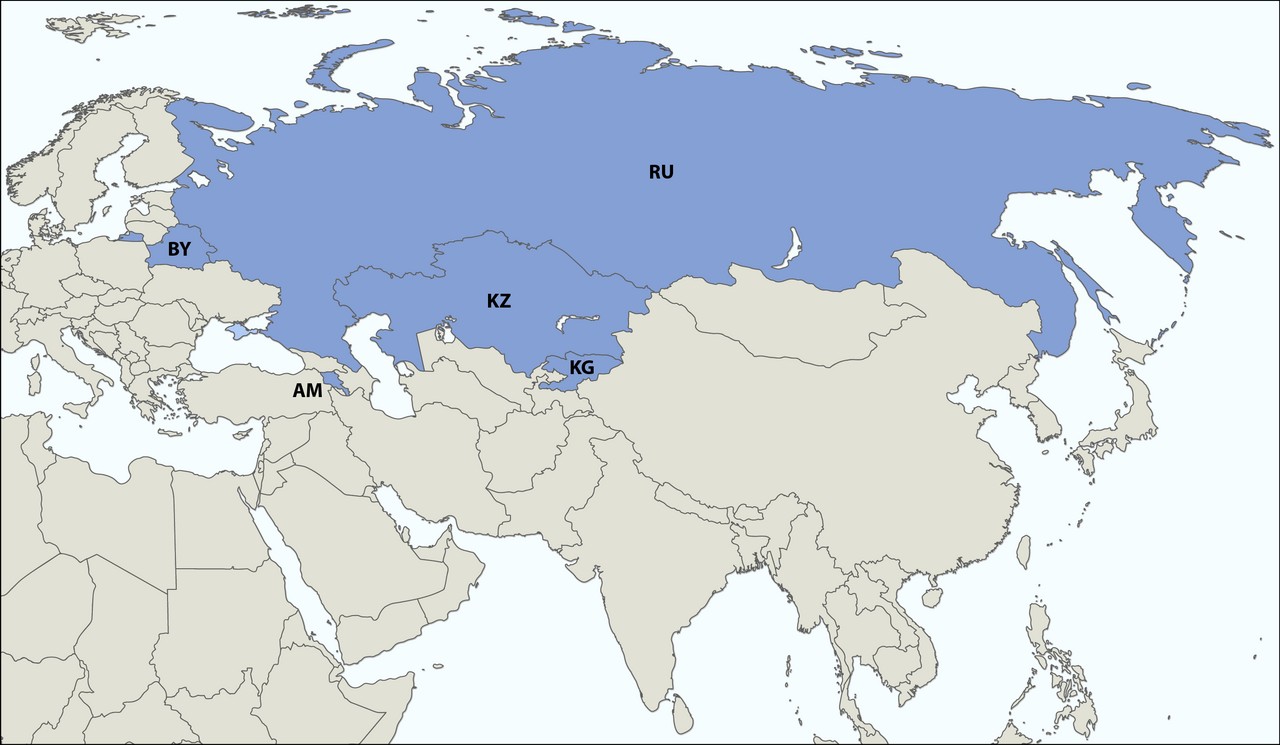
Map of the Member States of the Eurasian Economic Union (Crimea is disputed) by Maximilian Dörrbecker (Chumwa)
In addition, the EAEU continues to draw interest from the international community, showing that Moscow is far from isolated. The Eurasian Economic Forum – the first of the major May summits held in Astana (Kazakhstan’s capital), attracted over 3,000 delegates from 44 countries – from Cuba to Vietnam – confirming the attractiveness of Kazakhstan (if not Russia) as an emerging economy, but also the wider interest in the EAEU.
However, not far beneath the surface of these impressive trade figures and the well-attended Eurasian Economic Forum, the two other major summits held in Astana reveal both a short-term and long-term problem that Putin cannot ignore, as Russia attempts to retain its regional influence with the backdrop of war in Ukraine.
The short-term problem concerns Russia’s deteriorating relations with Armenia – a member of the EAEU since 2015 and Russia’s key partner in the strategically important South Caucasus. On May 28-29, the EAEU Supreme Eurasian Economic Council, comprising member state leaders, including Vladimir Putin, met in Astana to discuss further integration and expansion, but also the possible suspension of Armenia’s membership. Armenia has embarked on a pro-Western and pro-NATO-EU course following its devasting armed conflict with Azerbaijan (2020-2023), accusing Russia of undermining its sovereignty and failing to provide assistance, openly calling for closer relations with the West.
To make matters worse for Russia, pro-Western incumbent, Nikol Pashyanin and his Civil Contract Party secured re-election with 49.8% of the popular vote and a majority of seats in the Azgayin Zhoghov (Parliament) in the June 7 national election. Putin and other high-ranking officials have wasted little time in warning Armenia of the consequences of leaving Russia’s sphere of influence, including veiled threats of a ‘Ukraine scenario’ unfolding. Western policymakers are watching developments closely.
The final keynote diplomatic event hosted in Astana was the Russia-Kazakhstan summit held on May 27-29, as Vladimir Putin met his Kazakh counterpart, Kassym-Jomart Tokayev to discuss bilateral relations. This included the signing of a lucrative $16 billion deal that will see Russia’s powerful Rosatom atomic energy corporation build a new nuclear powerplant in Kazakhstan, thus cementing Russia’s long-term energy relevance and leverage in this important country.
Or so it seems. In reality, Kazakhstan has increasingly sought to balance relations with Moscow, in particular following the invasion of Ukraine in 2022. In 2025, Kazakhstan selected China’s National Nuclear Corporation (CNNC) to build not one, but two new nuclear powerplants in the country in what appears to a strategy of ‘soft balancing’ and a nod to China’s growing regional clout. In 2025, Kazakhstan’s trade with China reached a record $48.7 billion some way ahead of the reported $28 billion trade turnover with Russia.
For Putin, the summer of 2026 and this latest round of diplomatic activity, including the election in Armenia, is very much a case of one step forward and two steps back. Even with the success of the Eurasian Economic Forum and broader mutual trade within the EAEU, Russia faces sustained pressure from rival regional leaders, notably China, but also a revived EU and NATO in the South Caucasus. Moscow’s partners, it seems, continue to reassess and re-adjust their foreign policies and trade relations in response to developments in the region, including war in Ukraine.
Pictured top: Vladimir Putin and Armenia's pro-Western leader Nikol Pashyanin.
Back to media centre