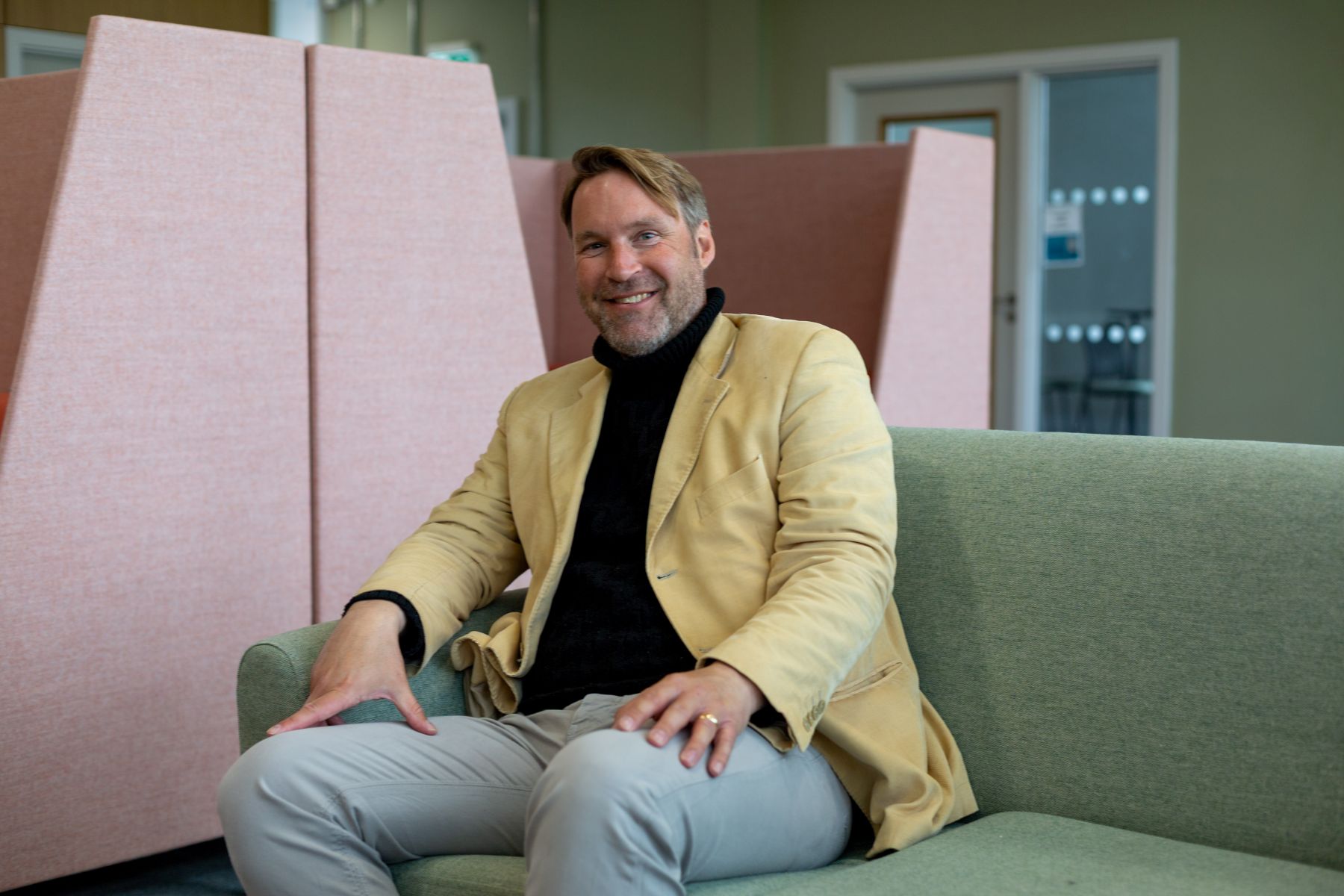
A University of Winchester academic has been awarded a prestigious research fellowship to advance his work in the field of Inclusive Refugee Education.
Wayne Veck, Professor in Education and Pathway Leader for Education Studies, received the award from the British Academy and the Leverhulme Trust. It will allow Professor Veck to develop an Inclusive Refugee Education framework and produce a book, an article, and a policy brief that he hopes will influence education policy.
Professor Veck succeeded against tough competition. His application was judged to be of “outstanding quality and originality” by the committee and was one of only 11 out of 158 to receive funding.
“I’m hoping to contribute to moving the field of inclusive education on, beyond special educational needs,” said Professor Veck.
His work is based on in-depth interviews with six refugees: two from Afghanistan and one each from Syria, Uganda, Ukraine, and Tibet. Professor Veck said that he felt their individual stories said more about the refugee experience in education than a wider statistical survey could, and that they could be used to shape practices, policies, and curricula.
While refugees can face prejudice, they can also be stereotyped as charity cases or problems to be solved.
“We have to recognise that people have experienced trauma, but not to see them merely as traumatised cases,” he said.
A common theme running through the refugees’ stories is that inclusion does not equal assimilation.
“Inclusion has to be more than an access issue. It’s not enough just to be given access to a school or university. You have to be accepted and included, able to contribute,” said Professor Veck.
At the heart of the project is the conviction that refugee education must be decolonised. Professor Veck means this in a practical and hopeful sense.
“It means starting not with what we think refugees need from us, but with what we can learn from them about how the world is, and how it might change for the better,” said Professor Veck.
He is wary, though, of the well-meaning impulse to rescue.
“The danger is the benevolent gaze, the one that keeps refugees as passive recipients to be sorted and helped, rather than people to be heard. Inclusion means encountering them as partners, not as burdens to be met with either charity or exclusion,” he said.
Professor Veck argues that the same colonial habits can decide in advance whose suffering counts. A person fleeing war in Ukraine, he notes, is more likely to be welcomed in the UK than someone from Africa or the Middle East.
The book, Inclusive Refugee Education: Decolonisation, Ethics, and the Pedagogy of Attentiveness, will be written in collaboration with Professor Michelle Proyer of the University of Luxembourg, and Mohamed Abdel Keream, of the University of Vienna, a practising schoolteacher, bringing together philosophical argument, comparative expertise, and lived experience of displacement.
The fellowship will allow him to devote a year to the project, away from his normal academic duties.
“It’s an amazing opportunity. It will be like being a PhD student again,” said Professor Veck.
Interim Vice-Chancellor Dr Angus Paddison said, "This is a highly prestigious award for the University to receive. We extend our congratulations to Wayne."
Back to media centre